
How CDAC’s Support Provided a Turning Point for Madam Yang’s Family
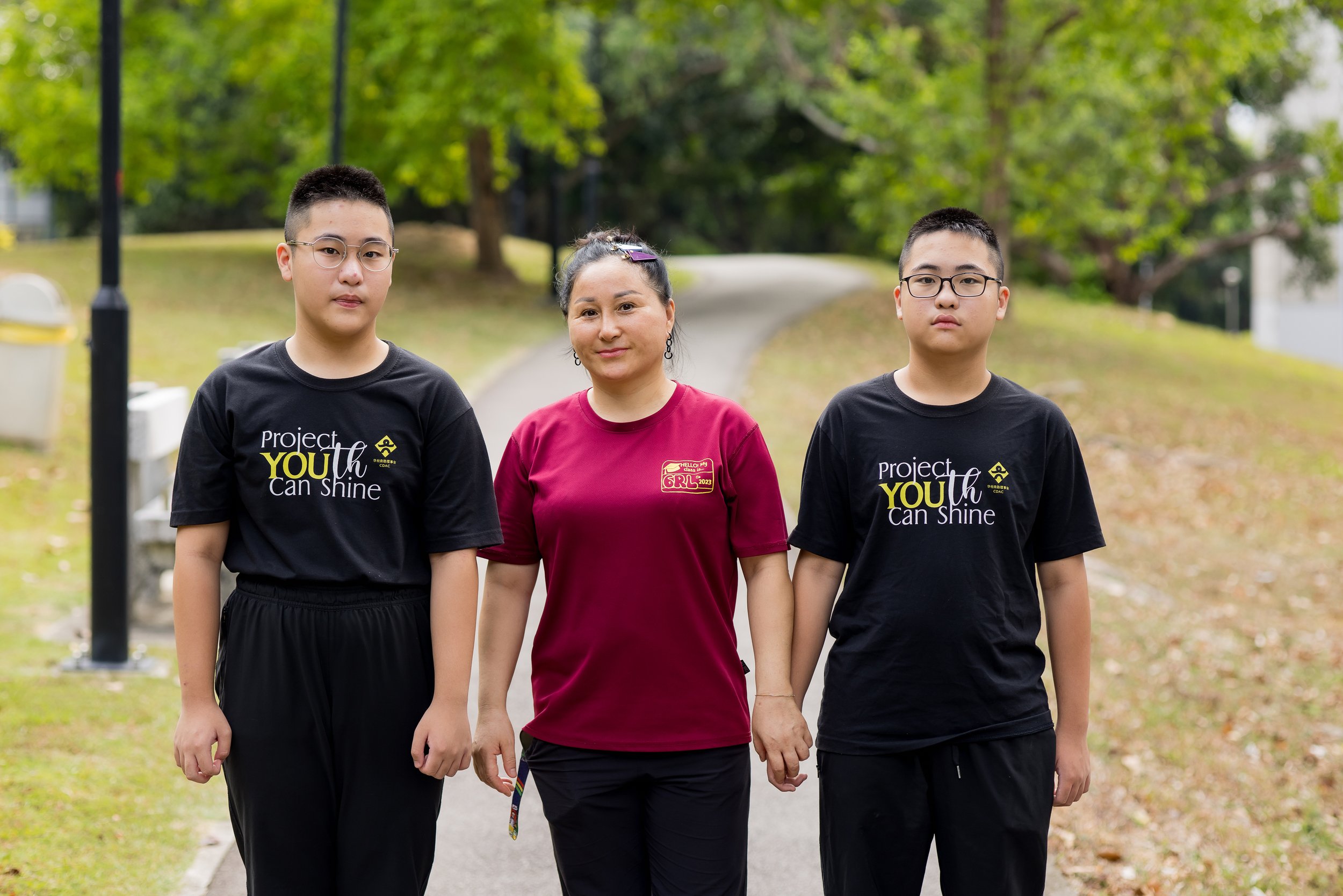
For years, Madam Yang Lixia, 52, carried an unspoken worry about her two sons and what the future might hold for them. The younger son, Wang Sheng Yuan, struggles with learning and social interactions, and often finds it hard to manage his emotions. The elder son, Sheng Wen, who is on the autism spectrum, is often misunderstood for not picking up social cues. Unable to work as she cared for both boys, the family relied on Madam Yang’s husband as their sole breadwinner.
Life used to feel uncertain for Madam Yang Lixia and her family of four. With two teenage sons to care for and a husband working long hours to support the household, she stayed home full-time because she was unsure if her children could cope on their own.
Communication with her children was often difficult, and daily routines could be unpredictable. “Before they joined Project YOUth Can Shine, I was full of worries,” she shared. “There were many things I couldn’t let go.”
That began to change when CDAC case worker Ms Goh Wan Yi reached out to Madam Yang. Having seen that both her sons were eligible, Ms Goh introduced the family to Project YOUth Can Shine (PYCS)—a tutoring and mentoring programme that supports lower secondary students not just academically, but also in building confidence, social skills and life competencies.
Madam Yang decided to give it a try. It turned out to be a turning point.
Growing Independence, One Step at a Time
At PYCS, students receive weekly academic support alongside mentoring from volunteers, who guide them in communication, behaviour and social interaction. For Madam Yang’s sons, these sessions made a visible difference.
Even before joining PYCS, the family had been supported through CDAC’s tuition programme and bursary scheme, which helped ease financial pressures and ensured the boys could keep up with their schoolwork. With this support in place, PYCS built on that foundation—helping them grow not just academically, but socially and emotionally as well.
Her elder son, Sheng Wen, 15, had previously struggled with following instructions and adhering to social boundaries. Everyday situations—like being in public spaces—could be challenging. “Before joining PYCS, he didn’t understand me, and I didn’t understand him,” she said.
Over time, with guidance from volunteers, he began to change. He learnt how to communicate more appropriately, listen with patience, and navigate social situations with greater awareness. Today, he is able to travel independently and even follow instructions over the phone. “Now, I feel like he’s almost like a typical child,” Madam Yang shared with a smile.
Finding Friendships and Confidence
For her younger son, Sheng Yuan, who’s also 15, the changes were just as meaningful.
He used to struggle with managing his emotions and had difficulty making friends. “He wanted friends, but he didn’t know how to make friends,” Madam Yang recalled. With support from PYCS, he began opening up through interactions with peers in a safe and encouraging environment.
Over time, Sheng Yuan started building friendships and taking initiative socially. He now exchanges voice messages with friends and even suggests meeting up during the school holidays— something he had never done before. “Now he tells me, ‘I want to ask my friends out,’” Madam Yang said. “When he’s happy, I’m happy too.”
As for Sheng Wen, some students at PYCS were unsure how to engage with him initially. But as they got to know him better, they became more understanding and inclusive—inviting him to join their games, guiding him along, and even sharing small gifts with one another.
In this supportive environment, both boys began to experience a sense of acceptance and belonging.
A Warmer, Stronger Family
The changes extended beyond the boys themselves. At home, the atmosphere began to shift.
The brothers now help each other with household chores—one doing the laundry, the other folding clothes. They clean and wash dishes without being asked.
“They used to argue and refuse to help. Now they divide the work themselves,” Madam Yang said.
Their relationship with their father has also improved. Once distant, they now greet him, make small talk, and even celebrate special occasions together. On his birthday, they surprised him with chocolates—simple gestures that meant a great deal.
“They didn’t use to interact much,” she shared. “Now, they have love in their hearts for their parents.”
They have also become more caring towards their mother. On days when she is unwell or running late, they check in on her and encourage her to take care of her health—something that was absent before.
Support That Goes Beyond the Classroom
For Madam Yang, the support from PYCS goes beyond academic help. The consistent guidance from Ms Goh and the volunteers has played a key role in helping her children grow.
“Whenever there was a problem, I would share it, and they helped us step by step,” she said. “We parents don’t always know how to teach these things, but they do.”
Beyond weekly sessions, CDAC also organises family bonding activities and outings. While her husband’s long working hours often prevent him from joining, he has always encouraged Madam Yang and their sons to attend. He enjoys hearing about their experiences, and these shared moments have brought the family closer in their own way.
With her sons becoming more independent, Madam Yang was finally able to return to work. “I felt I could let go,” she said. “That made all the difference.”
Looking Ahead with Hope
Today, Madam Yang hopes her sons can continue on this path—living independently, contributing to society, and building meaningful lives of their own.
“I hope they can live like other children, filled with joy and live a normal life,” she said. “And one day, I hope they can pass on the kindness they received.”
For families facing similar challenges, her message is simple:
don’t wait.
“Take the first step. Seek help early,” she said. “It can change everything.”